Central government has been subject to the off-payroll rules since April 2017, and departments are still paying for getting them wrong. The Cabinet Office has recognised a £38.5m IR35 liability in its 2025-26 accounts, and FCDO Services has set aside £14.8m. The causes are the same ones HMRC found in earlier cases: assessments that did not reflect how the work was really done, and failure to demonstrate reasonable care.
Last updated 10th November 2026.
If any part of the public sector should have IR35 under control, it is central government. Departments have had nine years under the public sector rules, access to HMRC's own guidance and, in many cases, HMRC's own CEST tool. Yet the accounts keep showing the same pattern: years of confident statements that the rules were applied with care, followed by a large bill once HMRC looks closely.
Which government departments have faced IR35 tax bills?
At least six central government bodies have disclosed IR35 liabilities in their annual accounts since the public sector rules began. The table shows what each reported, newest first.
| Departments | Accounts | Amount | What went wrong |
|---|---|---|---|
| Cabinet Office | 2025-26 | £38.5m including interest, of which £15m paid in February 2026. A possible penalty of up to £8.9m is not provided for | HMRC concluded in October 2025 that historic processes were inadequate and reasonable care was not taken. A 39% liability rate from sampled roles was applied across around £89m of off-payroll spend |
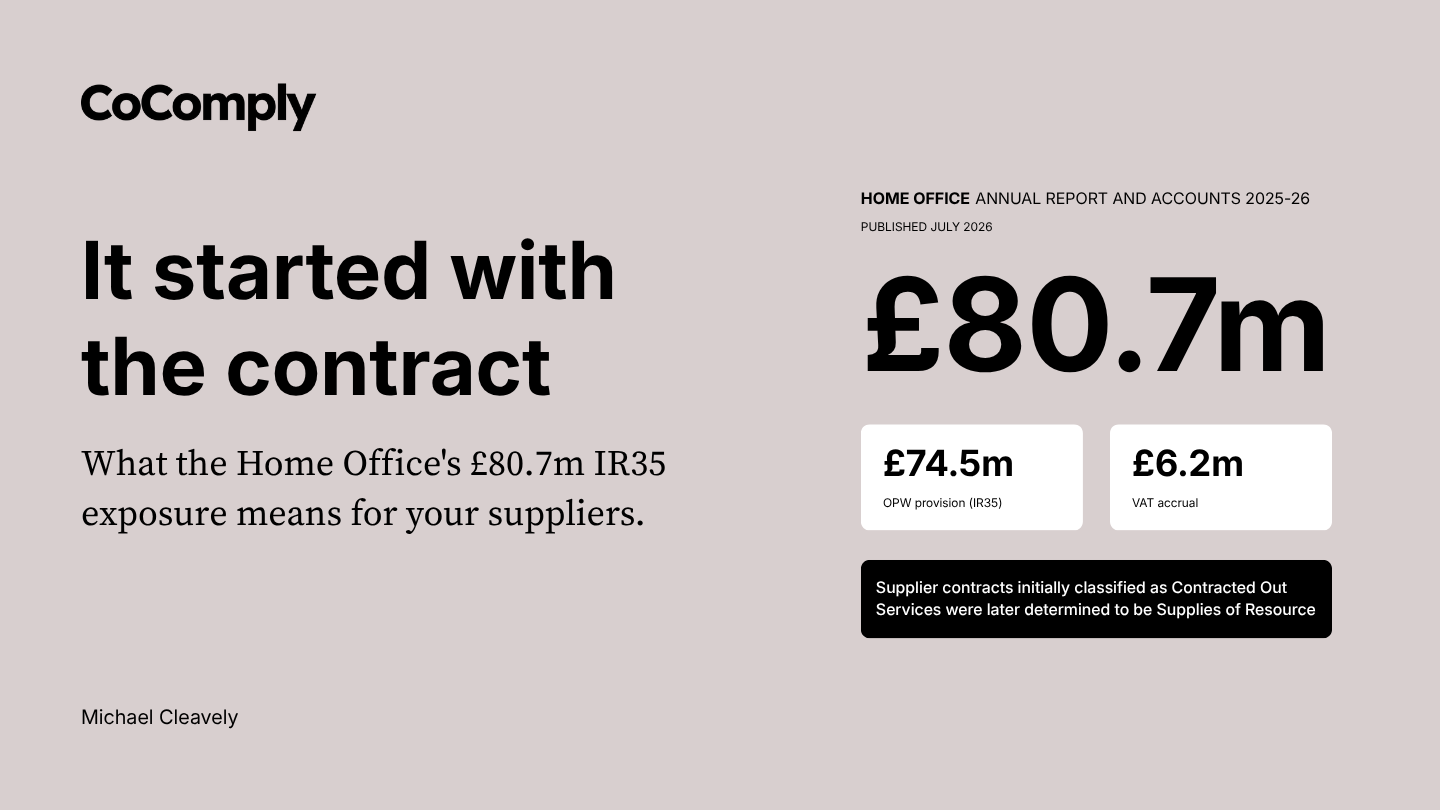
| Home Office | 2025-26 | £74.5m provision, plus a £6.2m VAT accrual | Supplier contracts originally classified as contracted-out services were later determined to be supplies of resource. This is the department’s second IR35 liability, after its 2020-21 bill |
| FCDO Services | 2025-26 | £14.8m provision covering 2021-22 to 2025-26 | A review found many engagements assessed as outside IR35 should have been inside. 42 of 50 reassessed engagements changed status |
| Ministry of Justice | 2020-21 | £72.1m including £4.5m interest, plus a suspended £15m penalty | Hiring managers concluded workers could send a substitute. HMRC disagreed and found the department careless |
| Department for Work and Pensions | 2020-21 | £87.9m including interest | Historic determination errors. The department used CEST |
| Defra | 2020-21 | £19m paid in March 2021, with a further £48m liability | Contractors incorrectly assessed as outside the rules, despite using CEST |
| Home Office | 2020-21 | £29.5m including interest, plus a £4m careless penalty | Contractors incorrectly assessed as outside IR35 since April 2017 |
The Foreign Office core department has also set aside an undisclosed sum, and 438 of its 500 in-scope engagements are now assessed as inside IR35.
Why do departments keep getting IR35 wrong?
The same four causes come up again and again.
- Assessments that do not reflect the real working arrangement. The Ministry of Justice's managers accepted that workers could send a substitute. HMRC looked at how the work was actually done and disagreed. A determination is only as good as the facts that go into it.
- Relying on CEST alone. DWP and Defra both used HMRC's own CEST tool and still faced large bills. CEST only works if the answers are accurate, and it does not replace evidence of how each role operates day to day.
- Failure to demonstrate reasonable care. For five years the Cabinet Office's accounts said the department had applied the rules "with care". HMRC's sampling found otherwise. Saying you took care is not the same as being able to show it.
- Problems found years later. Many of these liabilities go back to 2017 or 2021. Interest builds every year, and a single review can turn into a bill covering five years or more.
None of this is unique to the government. The same causes sit behind cases outside central government too, as we covered in the £104m IR35 lesson from the Post Office.
What should government bodies do now?
Start from the assumption that HMRC will test your determinations against real working practices, and make sure the evidence is there before it asks.
- Build a complete list of everyone engaged off-payroll, including people supplied through consultancies and service contracts
- Check every determination reflects how the role actually works, rather than relying solely on the contract or the hiring manager’s information
- Test substitution, control and day-to-day management with the people doing and managing the work
- Use CEST as one input, not the whole decision, and keep the answers you gave it
- Keep records that show reasonable care: who decided, on what evidence and when it was reviewed
- Re-check status on every extension or change in scope
- If you find errors, correct them and make a voluntary disclosure. HMRC now expects you to confirm whether other workers are affected and what you have done to stop it happening again
We cover the disclosure process in HMRC’s updated voluntary disclosure guidance, and how to build a complete list in How to find every contractor in your organisation.
CoComply is an external workforce compliance platform. It helps large organisations, including public bodies, classify each engagement based on how the work is done, keep the evidence that shows reasonable care and see their whole external workforce in one place.
Next step: Book a demo to see how CoComply supports public sector off-payroll compliance.
Frequently asked questions
When did the off-payroll rules start applying to central government? The public sector off-payroll rules have applied since April 2017. The private sector followed in April 2021.
Which government departments have had IR35 tax bills? They include the Cabinet Office, FCDO Services, the Ministry of Justice, the Department for Work and Pensions, Defra and the Home Office, each disclosed in their annual accounts.
Does using CEST protect a department from IR35 liability? Not on its own. HMRC stands behind CEST results only where the information entered is accurate, and it has become increasingly easy for HMRC to establish that CEST assessments have been completed inaccurately. DWP and Defra both used CEST and still faced large bills.
What does HMRC look for when it reviews a department? Whether determinations reflect how the work is really done and whether the department can show it took reasonable care, with records of who decided, on what evidence and when.
Sources
- Cabinet Office, Annual Report and Accounts 2025-26
- FCDO Services, Annual Report and Accounts 2025-26
- Computer Weekly, Defra and MoJ hit with £120m IR35 tax bill despite using HMRC guidance (Ministry of Justice and Defra 2020-21 accounts)
- Computer Weekly, HMRC hits Home Office with £33.5m bill over careless application of IR35 rules (Home Office and DWP 2020-21 accounts)
- HMRC, Next steps: correcting errors (GfC4, part 14)